New Research Reveals a Growing Compliance Gap in Advertising
Survey period: June 9–11, 2026
Sample: 100 advertising and marketing professionals
Industries: Healthcare, Financial Services, Real Estate, Higher Education, Advocacy, Non-profit, and more
A crisis may be unfolding inside marketing departments, agencies, and executive suites across the advertising industry. It doesn’t make headlines — at least not until something goes wrong. But the data is clear: the gap between the speed at which organizations create and distribute advertising content and the infrastructure they have in place to ensure that content complies with applicable law has become dangerously wide.
A new survey of 100 advertising and marketing professionals, conducted June 9–11, 2026, paints a picture of an industry operating under growing compliance pressure — and doing so largely without the tools, governance structures, or organizational clarity needed to manage it effectively.
The urgency is particularly high, given the acceleration of AI-generated content, a rapidly expanding patchwork of state and federal regulations, and the growing assertiveness of platform enforcement.
The question this report attempts to highlight is the advertising industry’s growing compliance problem and what could come next.
Part I: The Scale of the Problem
Compliance Uncertainty is Very Real
When asked how often their organizations encounter uncertainty about whether content complies with applicable laws, regulations, or policies, the response was striking : 85% of respondents said they encounter this uncertainty at some level. Of those, 41% said it happens “Often” or “Very Often.” Only 12% said they never face compliance uncertainty at all.
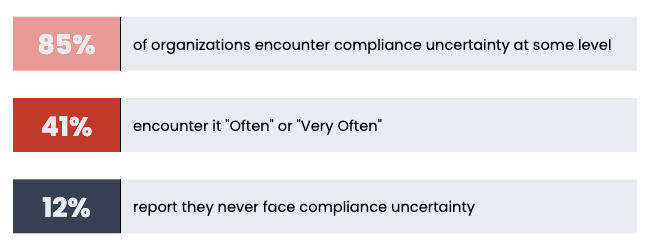
These numbers should give pause to any leaders who believes their organization has compliance “under control.” Compliance uncertainty is not a fringe problem only affecting a few industries.. It is baked into the daily operations of the industry. And it is getting more complex, not less.
When asked which compliance areas create the most difficulty, respondents pointed to a landscape that is multidimensional, overlapping, and increasingly technical:
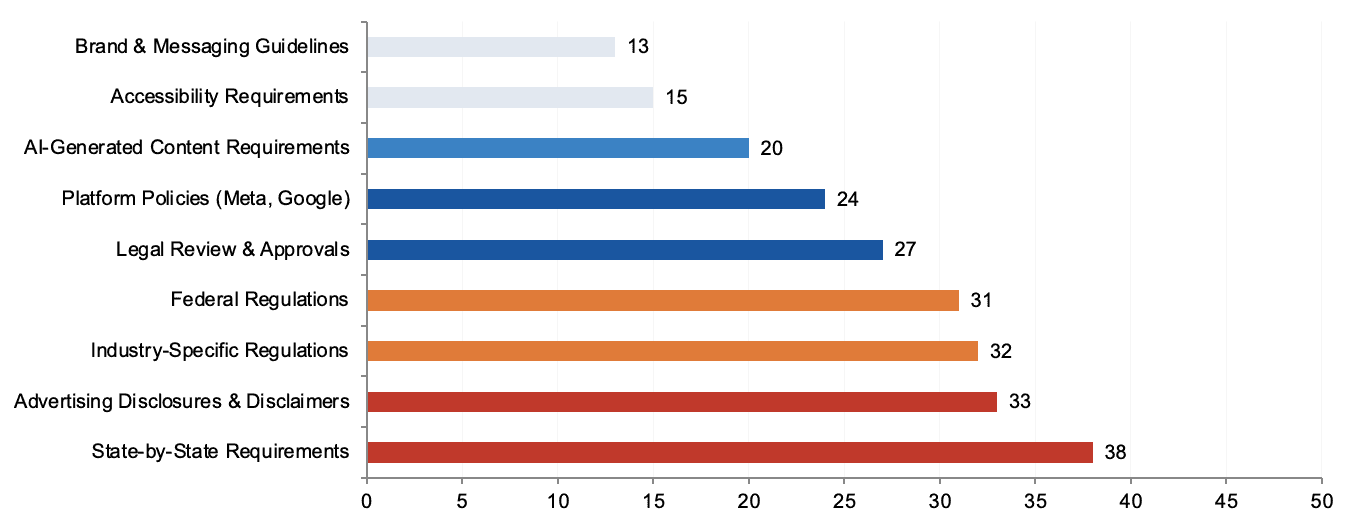
The geographic fragmentation topped the list - with 38% of respondents citing state-by-state requirements as a primary challenge. This reflects a compliance environment that has grown more complex since the wave of state privacy laws began in earnest in 2023. Organizations that once needed to track a handful of federal standards now face a patchwork of dozens of state laws, each with its own disclosures, opt-out requirements, and enforcement mechanisms.
Concern Is Growing
Compliance uncertainty, in isolation, might be manageable if organizations felt confident in their ability to navigate it. But the survey reveals that the uncertainty has developed into something more consequential: concern about the actual risk of non-compliance.
When asked how concerned their organizations are about missing a compliance requirement that could impact a campaign or advertising program, 58% of respondents described themselves as “Very Concerned” or “Extremely Concerned.” Only 6% said they were not concerned at all.
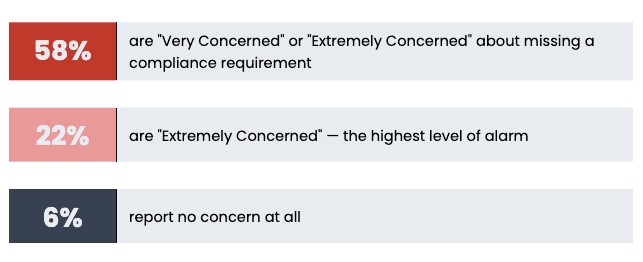
What makes these numbers particularly significant is the gap they reveal between stated concern levels and the organizational investment being made to address them. As we will discuss in Part II, the vast majority of organizations do not have the governance infrastructure that a 58% “high concern” rate would seem to demand.
This is not a situation in which awareness is lagging behind risk. Awareness is acute. The deficiency is in the organizational response.
Part II: The Business Cost Is Real and Measurable
One of the most important findings of this survey is that compliance failures are generating tangible costs across the organizations that responded. When asked whether their organizations had experienced specific compliance-related challenges, 88% reported at least one material impact. Only 12% reported no compliance-related impacts at all.
The impact categories are instructive, not only for what they reveal about current pain, but for the secondary effects they carry:
33% report that compliance concerns have limited their use of AI tools — effectively creating a tax on innovation
30% have experienced delayed content or campaign launches due to compliance review
29% have had to require revisions after legal review — often late in the production cycle
27% have seen increased outside legal costs attributable to compliance uncertainty
23% cite concern about regulatory enforcement as an active business concern
21% have actually reduced their advertising activity as a result of compliance concerns
18% report difficulty scaling content production due to compliance constraints
“For one in three organizations, compliance concerns are actively constraining AI adoption — representing both a cost and a competitive disadvantage.”
The most common impact — constrained AI adoption — has implications that extend well beyond compliance. Organizations that cannot confidently use AI in content creation will fall behind competitors who can, because content performance and execution speed are critical to winning. When compliance uncertainty becomes a barrier to technology adoption, it is no longer merely a legal problem. It is a strategic one.
The same logic applies to campaign delays. In an industry where timeliness is often the difference between a campaign that lands and one that misses its moment, a compliance review process that consistently causes delays is inefficient and a structural disadvantage.
And the legal costs are not trivial. With 27% of organizations reporting increased outside counsel fees driven by compliance review needs, the financial case for more efficient compliance infrastructure becomes self-evident. Organizations spending on reactive legal review could, in many cases, fund proactive compliance capabilities for the same or lower cost.
Part III: AI Is Accelerating the Problem Faster Than Governance Can Respond
The Adoption Curve Is Steep
Perhaps the most consequential finding is not just about compliance and risk but what is occurring alongside rapid AI adoption and governance concerns.
AI is not a future consideration for advertising and marketing organizations. It is a present reality. When asked whether their organizations currently use AI to create content, 83% of respondents said they are using or exploring it in some way to create content.
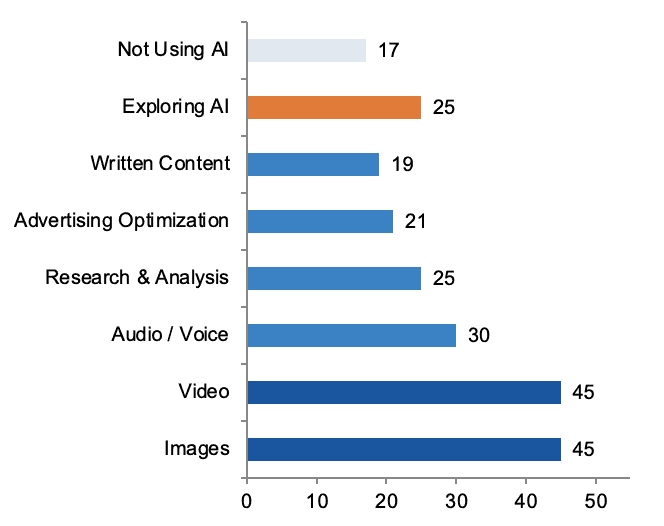
These are not organizations dabbling at the edge of AI adoption. They are deploying it at scale, across the most visible and consumer-facing elements of their content production. And yet, when asked about their concerns regarding AI-generated content, the top responses reveal a set of compliance-adjacent anxieties that the organizations do not appear to have systems in place to address:
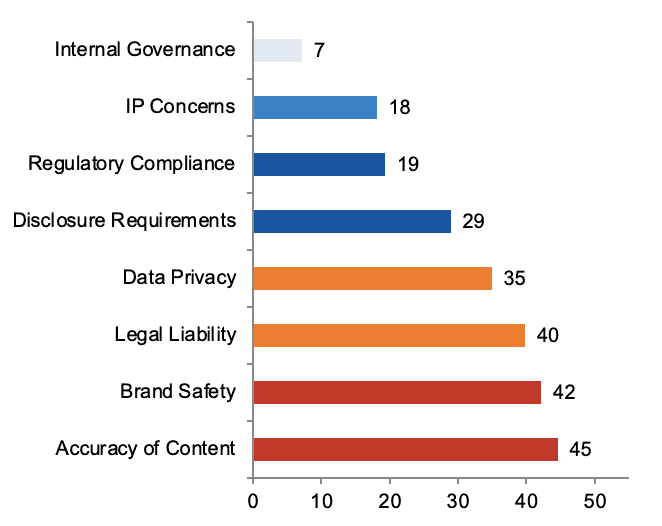
Together, this data describes a scenario in which organizations are using AI at scale, are aware of the compliance risks it creates, and have nonetheless not established governance frameworks commensurate with those risks.
The Governance Gap Is Widening
The AI governance data is where the gap between risk awareness and organizational readiness becomes most acute. When asked how often their organizations encounter uncertainty about whether AI-generated content complies with applicable laws, regulations, or platform policies, 43% said “Often” or “Very Often.” Only 12% said never.
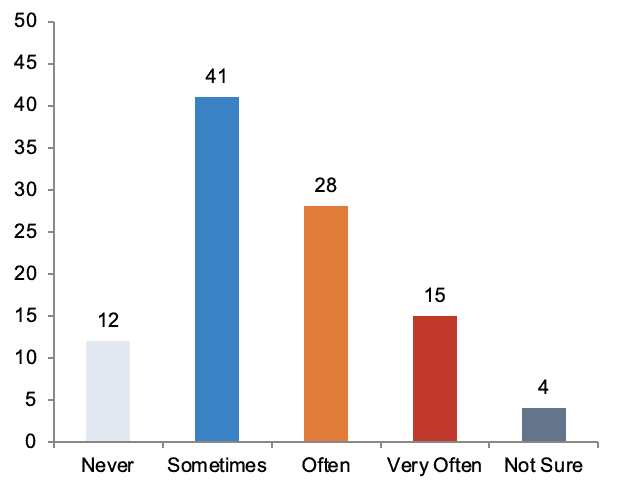
Set against that backdrop, the governance maturity data is troubling:
17% do not actively monitor AI-related regulations or have formal AI governance practices at all
34% only monitor AI regulations “occasionally when needed” — a reactive rather than proactive posture
20% have informal processes for reviewing AI-generated content but nothing formalized
Only 10% have established internal AI compliance policies and review processes
Only 14% have dedicated legal or compliance resources actively monitoring AI regulations
“Only 24% of organizations have formal AI compliance policies or dedicated resources, while 43% regularly encounter AI-specific compliance uncertainty. The gap between exposure and governance has never been wider.”
This is the defining tension of the moment in advertising compliance. Organizations are generating AI content at scale, they are aware of the legal and regulatory risks that creates, and fewer than one in four have the governance infrastructure to manage those risks systematically. The other three in four are, effectively, operating on faith — trusting that nothing will go wrong, or that when it does, they will be able to respond quickly enough.
That is not a strategy. And as enforcement activity increases — at the federal level through the FTC and at the state level through a growing number of AG offices — the window for that approach is closing.
Part IV: The Market Is Ready for a Solution
One of the most commercially significant findings in this survey concerns not the problem itself, but the appetite for a solution. When respondents were asked whether they would be likely to use a platform that could automatically review content for compliance risks before publication, and generate content that meets those requirements, the response was unambiguous.
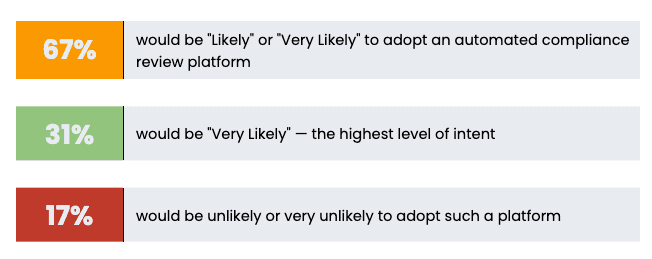
The adoption intent is consistent across roles, with particular strength among the decision-makers who would drive purchasing:
The high adoption intent (44% ) of Creative and Design professionals is particularly noteworthy. It suggests that the compliance burden is felt acutely even by the people whose work it most directly constrains, and that there is genuine appetite for a solution that reduces friction without requiring creative teams to become compliance experts.
33% of executive leaders reported being very likely to adopt a solution. Organizations that are cautious but open represent a significant secondary market opportunity for any solution that can demonstrate efficacy with early adopters.
The Bottom Line
The combination of compliance uncertainty, high levels of concern, measurable business impact, and a massive governance gap in AI content describes a system that is under increasing strain and has not yet made the investments required to manage that strain sustainably.
The urgency is not hypothetical. Regulatory enforcement is increasing. Platform policies are tightening. State legislatures are not slowing down. And AI-generated content — which 83% of organizations are already using — is creating compliance exposure faster than most organizations can track, let alone govern.
But there is also genuine optimism and opportunity. The appetite for better solutions is real. Two-thirds of respondents said they would adopt an automated compliance review platform. The market is not waiting to be convinced that the problem is real, they are looking for a solution.
“Organizations that invest now in structured compliance capabilities will not only reduce legal and reputational exposure — they will unlock a sustainable competitive advantage in an industry where trust is the scarcest commodity.”
Organizations will have no choice but to adopt solutions, but the question is who will be able to not only lead this but scale quickly, and who will have to play catch up.
About This Survey
This report is based on a survey of 100 advertising and marketing professionals conducted June 9–11, 2026. Respondents represent a cross-section of industries including Healthcare (20%), Financial Services (18%), Real Estate (14%), Higher Education (11%), Non-profit (10%), Insurance (7%), Agency/Consulting (6%), Legal Services (4%), Pharmaceutical/Life Sciences (3%), and other sectors. Roles include Marketing (24%), Executive Leadership (18%), Communications/Public Relations (15%), Digital Advertising (14%), Strategy (11%), Creative/Design (9%), and other functions (9%). The survey was conducted via an online panel. Results are directional and intended to illuminate industry trends rather than provide statistically definitive population estimates. For the survey results and data please email [email protected]